A Hidden Sea Sanctuary on Earl Grey's Estate
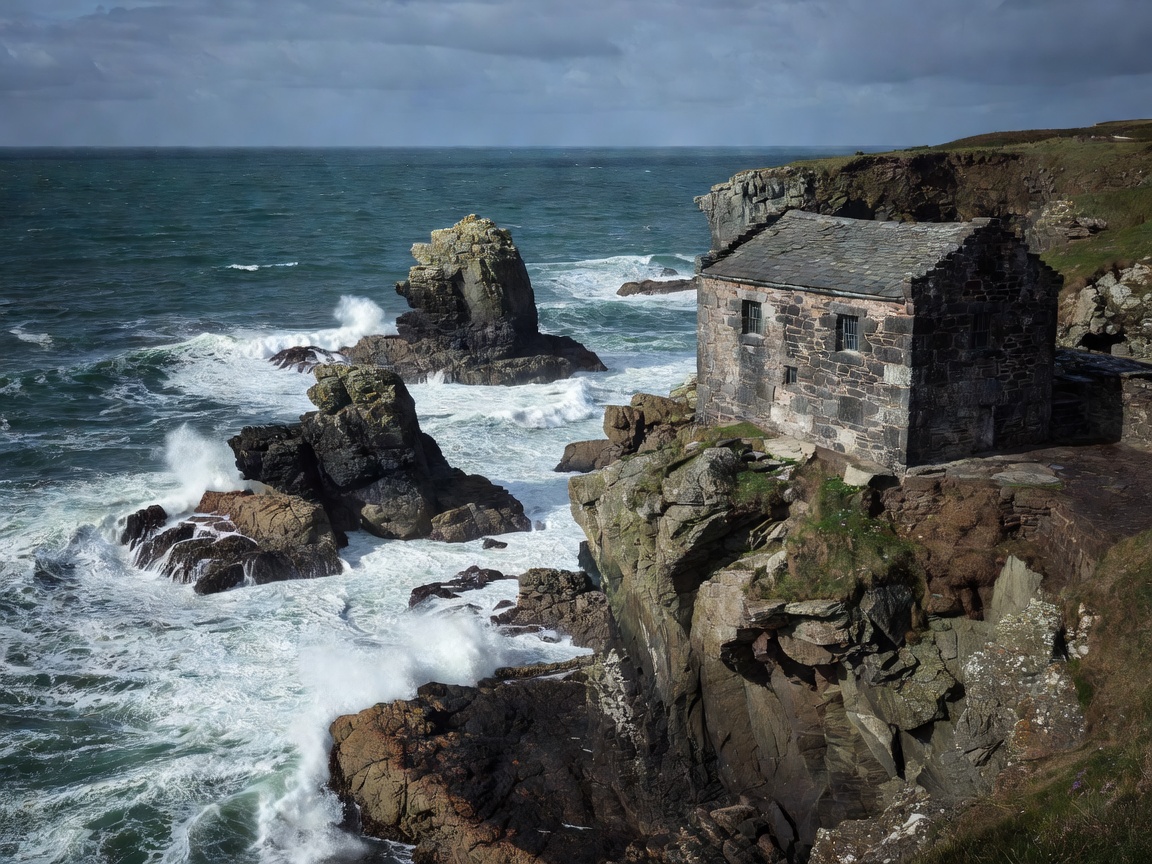
Directly east of the renowned rhododendron gardens and arboretum of Howick Hall lies one of Northumberland's most intimate shoreline scenes. Rumbling Kern is a discreet rock cove sheltered behind high walls of dark quartz-dolerite rock.
The name "Rumbling Kern" (literally "churning churn") refers to a deep, natural blowhole and amphitheater hollowed out of the basalt by millennia of wave compression. As rough seas surge into the fissure at mid-to-high tide, trapped air and water churn violently, producing a distinctive subterranean booming rumble that echoes through the surrounding cliffs.
The Bathing House Heritage
Overlooking the inlet stands the striking stone Bathing House, constructed in the early 19th century by Charles Grey, the 2nd Earl Grey (British Prime Minister responsible for the Great Reform Act of 1832, after whom Earl Grey tea was named).
The Earl built the retreat so his family and their fifteen children could enjoy sea bathing in the private, sheltered rock-pool created within the cove, protected from prying public eyes. Today, the building serves as a privately owned holiday home, yet the surrounding foreshore, beaches, and clifftop public bridleways remain fully accessible to walkers following the Northumberland Coast Path.
Geological Significance: The Whin Sill at Howick
Just south of Rumbling Kern, the coastline exposes the famous "Howick Fault," a dramatic geological boundary where light-coloured sandstone layers were sheared and folded against the dark, igneous intrusion of the Whin Sill. This site is widely studied by geologists as one of the finest exposed tectonic fault lines in northern England.
Trail Guide: The Howick Dene Circular
One of the most rewarding short walks in the area combines woodland streams and dramatic sea cliffs in a 4-mile loop:
- Trailhead at Howick Hall: Park in the visitor car park at Howick Hall Gardens. Head east along the path running alongside the Howick Burn through the peaceful wooded dene, carpeted with wild snowdrops in February and bluebells in May.
- Emerging at Rumbling Kern: The dene opens dramatically onto the North Sea at the mouth of the burn. Follow the coastal path north past the Bathing House into the Rumbling Kern inlet.
- Cliff Path northward toward Cullernose Point: Continue north along the elevated dolerite clifftops toward Cullernose Point, a dramatic rocky headland that marks the southern bastion of the Dunstanburgh Castle bay. Return via inland field paths through Howick village.
Pros and Cons for Explorers
Rumbling Kern provides a serene alternative to the bustling harbour front of nearby Craster, but visiting requires appropriate equipment:
| Element | Strengths | Potential Limitations |
|---|---|---|
| Scenery & Photography | Exceptional mixture of historic architecture, surf, and geology. | Bathing House is private property; photography is exterior only. |
| Accessibility | Gentle gradient walking along the Howick Dene stream path. | Accessing the pebbly cove floor requires scrambling down rock ledges. |
| Swimming & Dipping | Natural sheltered sea pool inside the kern at gentle tides. | Dangerous rip currents outside the cove; cold North Sea water. |
| Crowds | Very low pedestrian traffic compared to Craster village. | Very limited parking along the minor road; best walked from Howick. |
Respecting the Coastal Countryside
The cliffs around Howick host vulnerable ground-nesting pipits and skylarks. Walkers should remain on designated clifftop tracks and avoid walking along fragile field boundaries. As with all locations along this wild shore, bring a bag for litter, as no refuse bins are provided on coastal tracks.