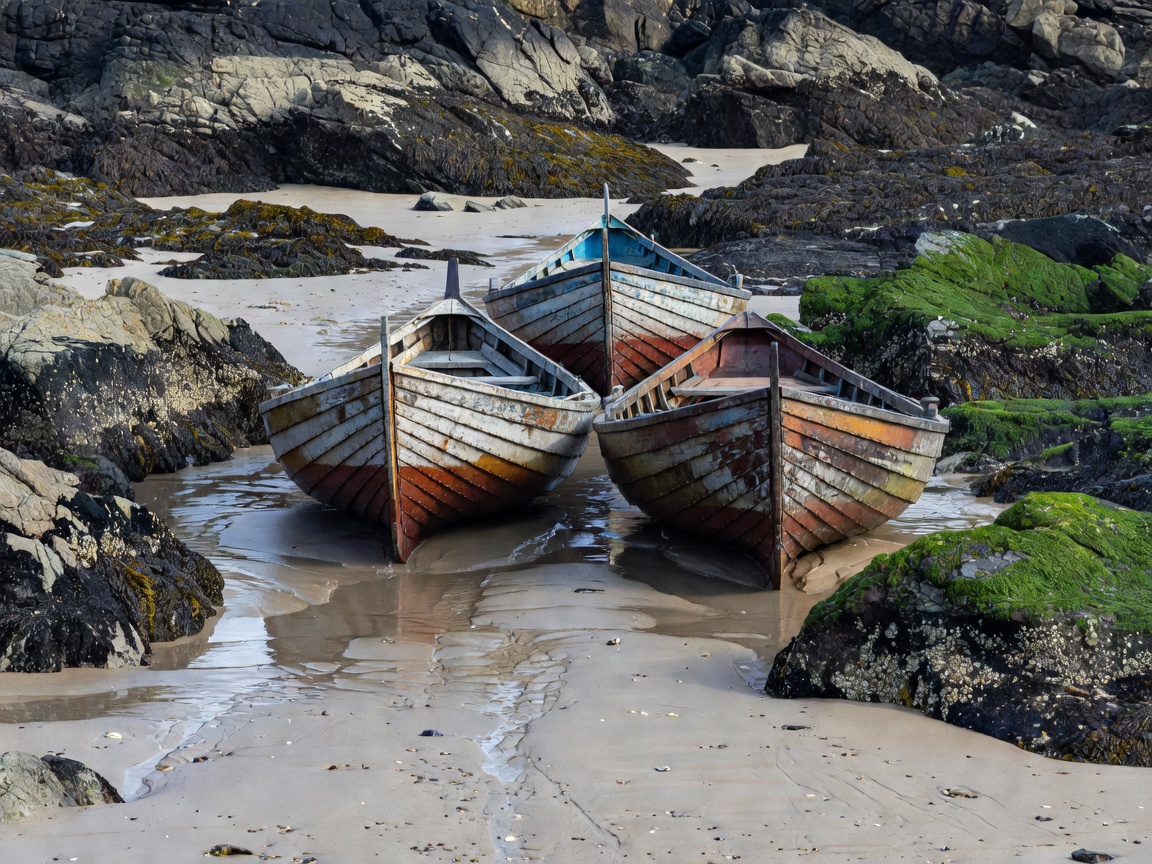
A Harbour Built by Geology, Not Stonemasons
Along the entire eastern coast of Great Britain, almost every established fishing community relies upon granite or sandstone harbour piers, sea walls, or locks to shield vessels from North Sea squalls. Boulmer stands as a unique exception. The village possesses no artificial breakwater or stone quay whatsoever.
Instead, vessels rely entirely upon an intricate series of natural offshore dolerite and sandstone reefs known as the "Mormor" and "The Torrs." These rocky spines break the primary impact of incoming swells, leaving a narrow, serpentine tidal channel through which experienced local skippers navigate their craft into the relative calm of Boulmer Haven.
The Architecture of the Northumbrian Coble
The continuation of fishing at Boulmer was made possible through the distinct naval architecture of the Northumbrian coble. Developed across centuries of trial in treacherous inshore shallows, the coble features characteristics unseen in standard keel-boats:
- High, Raked Bow: A sharply flared and pointed bow designed to punch through steep, foaming surf during beach launches.
- Flat, Tumblehome Stern: The flat floor toward the stern allows the boat to slide over sandbanks and be backed directly up onto the gravel beach stern-first.
- Deep Forefoot & Twin Bilge Runnels: The deep forefoot provides lateral bite when sailing into the wind, while long wooden runners on the underside protect the hull when sliding across sandbars.
Working Waterfront Courtesy
Boulmer is not an open-air museum—it remains an active working fishing community. Visitors should maintain respectful distances when tractors are hauling cobles onto the sand, avoid stepping on coiled ropes or lobster pot lines, and keep dogs strictly restrained near fishing gear.
Smuggling Lore & The Fishing Tavern
Throughout the 18th and early 19th centuries, Boulmer's secluded natural reef channel made it the primary smuggling nexus of Northumberland. Contraband gin, French brandy, salt, and tea landed from Dutch luggers were swiftly transported inland across secret moorland trails toward the Cheviot Hills and the Scottish border.
At the heart of the village stands The Fishing Boat Inn, situated right upon the tide-line. Overlooking the moored cobles, it has served fishermen and coastal travellers for generations, offering local crab sandwiches and ales while North Sea waves break within yards of its dining terrace.
Village Walking Trails & Wildlife Observation
The coastline flanking Boulmer offers some of the most serene low-tide walking in the region. Walking southward from the village takes you along low sand shelves directly into the Sugar Sands inlet within 30 minutes. To the north, the path follows grassy cliff-tops towards Howdiemont Sands and the fishing village of Craster.
The intertidal reefs exposed at low water support vast foraging grounds for wading birds. Redshanks, oystercatchers, curlews, and turnstones feed continuously along the kelp beds, while grey seals routinely haul out on the outer rocks of The Torrs during neap tides.
| Activity | Season / Timing | Local Practical Notes |
|---|---|---|
| Watching Coble Launches | Early morning (Weather dependent) | Subject to daily tide times and fishing permit allowances. |
| Rockpooling & Reef Walks | Low water neap tides | Slippery serrated wrack algae; wear non-slip boots. |
| Coastal Path Hiking | Year-round | Well-marked grass tracks connecting south to Howick and north to Craster. |
| Bird Watching | September through March (Overwintering) | Excellent vantage from village headland with spotting scope. |